


ICORN at 20: A Network of Free Expression Resisting to Protect “Islands of Roses” by Firas Saadoon and Safaa Khalaf

Once we had stepped off the train at Oslo Airport, Hussein Al-Dahir told me he was afraid of flying. We were part of a delegation from Vestfold County in Norway heading to Barcelona to attend the ICORN General Assembly for the first time, and to celebrate the 20th anniversary of the network’s founding in Stavanger.
I tried to put Hussein at ease, telling him he wasn’t alone; I shared that fear myself, in one way or another. However, this time, I found myself setting my own unease aside, focusing instead on reassuring him. I joked with him that turbulence was nothing compared to the shocks dealt by dictatorships, repressive parties, and armed militant groups. We had, against all odds, survived their wars and attacks, their bullets and explosives in Iraq and Syria. And now, here we are, heading to celebrate our deliverance from them through our ICORN Cities of Refuge, as the network launches its third decade of international work.
"Rose Island" and "Cities of Resistance"
Once the plane levelled after take off, we began watching Rose Island, an Italian film that seemed fitting for our journey. The film closely reflected our experience as newcomers seeking refuge in these cities and our determination to create small, self-made islands where we can stand to defend our causes, our rights, and our freedoms.
However, those in power rarely tolerate defiance. Oppressive authorities often respond with overwhelming force, as demonstrated by the fate of Rose Island. In different ways, the same fate befell us. However, we were scattered across cities that chose to stand with our dissent and resistance, cities that remain, in many ways, “in a state of resistance,” the aptly chosen and brilliant theme of the 2026 ICORN General Assembly.
Resistance is a courageous value in the face of those who would drag the world toward submission, and both Barcelona and ICORN stand as fitting examples of how that value can be upheld.
The moment we stepped out of Barcelona Airport on the evening of Sunday 19 April, we immediately noticed the tall, graceful Washingtonia palms swaying in the Mediterranean breeze. They evoked a sense of familiarity with a homeland one has known for a long time yet felt for the very first time, too!
On Monday morning, as we approached the metro Glòries station, we were greeted by the Sagrada Família, the most famous church and a masterpiece by Antoni Gaudí, a leading figure in modern Catalan architecture. We were tempted to visit it and capture some photos, maximising the hour we had free before our official schedule commenced. Due to landmarks such as this church, the capital of Catalonia has been transformedin to an open-air museum.
We took the metro to the Universitat metro station, whose name is drawn from the nearby University of Barcelona. Just across from its main building stood the venue of the ICORN GA, held at the CCCB – Centre de Cultura Contemporània de Barcelona, a cultural institution housed within a 19th-century complex in El Raval, one of the historic quarters of the old city. El Raval is often described as a “microcosm of the world" and, just as often, a "neighbourhood of beautiful contradictions."
New Members and Creative Networking

Each time, the GA of ICORN gives priority to inviting new members to the meeting, and I was pleased to attend for the first time. Reflecting this focus, the opening session, 'Creative Networking,' brought together participants from Scandinavia and Europe and was moderated by Abduljabbar Al-Suhili.
During the session, participants introduced themselves as writers, journalists, artists, and activists. They exchanged contact details, shared insights into their work and interests, and discussed opportunities for future collaboration through events, conferences, exhibitions, and joint initiatives within the ICORN network.
“Networking is essential for enabling both long-standing and new members to exchange experiences and expertise. It creates valuable opportunities that can be developed and put to meaningful use.” Al-Suhili noted.
A Grand Reception in the Gothic Quarter
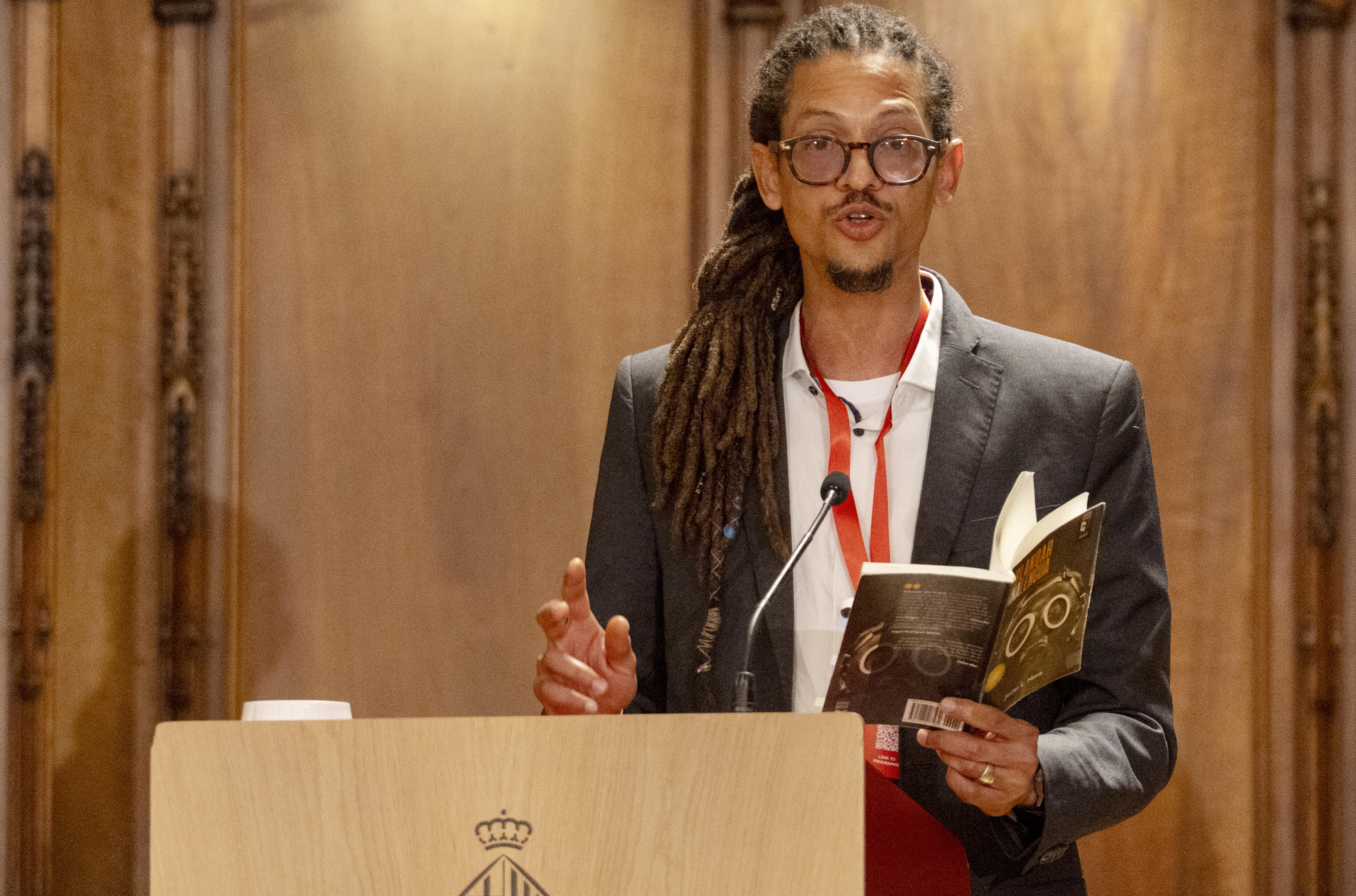
On the afternoon of April 20, the gentle warmth of the spring sun cast a soft glow over the Gothic Quarter, making it all the more enchanting. Amid its medieval architecture stand some of Catalonia’s most important government buildings. At its heart, in Plaça de Sant Jaume, rises Barcelona City Hall, where an official reception for the ICORN General Assembly was held.
The event was hosted by Jaume Collboni, Mayor of Barcelona, inside the historic Saló de Cent – the “Hall of One Hundred", a name that comes from medieval times, when Barcelona’s governing council consisted of one hundred members overseeing the affairs of the city. Today, it serves as the grand ceremonial hall for official receptions and the welcoming of distinguished guests.
Not a single inch of step back on freedom of expression
Mayor Collboni spoke of Barcelona’s historic role as one of the oldest cities within the ICORN network; it took part in the network’s founding in 2006 and launched the ‘Barcelona Writer-in-Residence’ programme, and welcomed its first guest writer the following year. He emphasised the growing importance of the network since its establishment 20 years ago in protecting journalists, writers, and artists, and ensuring freedom of expression.
“It is an honour for us to host this event and mark the 20th anniversary of ICORN... It is a source of strength for Barcelona, for freedom and peace, and for all those who defend human rights and protect those seeking a safe haven.” Collboni said.
Collboni added, “We gather to speak about democracy at a time of global backsliding. As threats persist, cities more than ever are becoming havens for rights and freedoms and guarantors of protection for those at risk,”emphasising the need to uphold the defence of freedom of expression and human rights on the basis of shared spaces: “We must build a better world.”
He also pointed to the recently announced “Barcelona International Peace Prize,” unveiled just a week before the ICORN GA, which aims to honour an individual, organisation, or institution making a significant contribution to promoting peace, co-existence, human rights, and the peaceful resolution of conflicts.
Laura Huerga, President of PEN Català, spoke proudly of being part of this event and joint initiative, which champions freedoms, rights and cultural diversity, in the first city to welcome a guest from ICORN and to help protect activists from persecution, and she expressed her appreciation for the collaboration with ICORN.
Annika Strömberg, the now former Chair of the ICORN Board, addressed these challenges, stating that “freedom of expression has been curtailed amid major crises”, and noting that “we need to stand together as apower and defend these freedoms”.
“ICORN is present in more than 90 cities and continues its work, having been active in around 30 cities in 2010. We need to keep going to protect freedom of expression, debate and activists,” she said, expressing her gratitude to Barcelona and all the Catalan institutions involved in hosting the ICORN GA.
The event was attended by Salem Zenia, the first ICORN resident hosted by Barcelona, as well as its most recent ICORN resident, Zainab Saberi.
“Today, we gather to celebrate more than just an anniversary,” Zenia said.
Zenia, originally an Amazigh from Algeria, shed light on aspects of his experience of integrating into the city of refuge, where he worked in journalism and published literary works ranging from novels to poetry collections; he also co-published a Catalan–Amazigh dictionary.
Saberi, a writer and journalist from Afghanistan, spoke of “a miracle that happened to her in the wake of the suffering of Afghan girls,” Referring to ICORN and its partners, saying:
“We faced nightmares, but you saved us and gave us hope. You guarantee the freedom to write and express ourselves without fear, and you stand up for humanity.”
The reception also featured poetry readings by Javier L. Mora and Simona Škrabec, along with a musical performance by members of the Stavanger Symphony Orchestra.

The Keynote speech at the CCCB rounded the first day of the GA, where the writer Ece Temelkuran and Laura Huerga, the president of PEN Català, looked at the notions of exile, refuge, and home to offer us a new model for global coexistence. You can watch the whole interview via this link: Unhomed: Displacement, refuge and new belongings in a fractured world. Ece Temelkuran in conversation with Laura Huerga
The ICORN Family Gathering: Challenges and Struggle
On Tuesday morning, the opening plenary of the ICORN GA, titled “Cities of Resistance: Our Shared Work for Freedom of Expression", opened with remarks by Helge Lunde, ICORN Executive Director. Drawing on his decades of experience in the field of free expression, he gave a historical overview of the network’s foundation, its various stages of development, and the challenges it has faced so far.
Helge said, “In 2016, we gathered in Paris to celebrate 10 years of ICORN. The theme was the road to changing the world runs through City Hall. At the time, we had grown to 50–60 member cities and hosted around 150 at-risk artists across roughly 19 cities. The future seemed open and bright, and ICORN appeared poised to continue expanding globally.”
He added, “But ten years on, I would point to two major challenges we have faced, and two reasons why I remain more convinced than ever that ICORN can continue to grow and play an increasingly important role in making the world a better place.”
Helge identified the withdrawal of NATO forces and their allies from Afghanistan in 2021 as the first challenge, which exposed many writers, artists, and activists to serious risks such as persecution, arrest, and execution. Thousands urgently requested protection and support, but not all could be accommodated. It raised a difficult question: How can ICORN uphold dignity, clarity, and fairness in the face of a surging demand for solidarity and urgent support?
Then he outlined the second challenge: a global surge in populism and xenophobia between 2024 and 2026, both within Europe and beyond. At times, he noted, a dominant narrative has taken hold: that unless democratic governments adopt stricter measures and close their borders, the far right will rise to power and threaten democracy itself. This has led to a complex and difficult work environment, where the protection of democracy intersects with increasingly restrictive policies on asylum and migration.
Helge noted that since 2021, ICORN has continuously improved its systems for processing, assessing, and allocating applications to better protect at-risk writers and artists.
“It has not been easy, and it still isn’t, but I want to express my deep pride in our highly skilled team of researchers, caseworkers, specialists, and residency programme developers who work tirelessly to ensure that ICORN becomes a resilient, robust, and sustainable organisation for the protection of freedom of expression,” he said.
Since its founding in 2006, ICORN has provided refuge to around 400 writers and artists at risk.
Testimonies: Country Focus
Within the ICORN community, there is a strong belief that the struggle must continue as long as violent regimes and conflicts exist. Members shared testimonies from countries experiencing wars, crimes against humanity, suppression of uprisings, silencing of dissent, and execution of opponents.
Bangladesh

Pranto Palash presented a historical account of gender- and religion-based persecution in Bangladesh. He detailed the repression, displacement, and emigration experienced by himself and fellow activists as they continued to oppose oppression and call for justice against the perpetrators of these crimes.
Palash described a deteriorating environment for journalists in Bangladesh, with many facing imprisonment, dismissal, or exile. He observed increasing restrictions on freedom of expression, though some continue to publish through alternative platforms, such as social media and independent websites, which allow them to bypass traditional censorship. In his place of refuge, he emphasised his responsibility to share the truth and highlighted the essential role of ICORN writers and artists in maintaining a free society.
Sudan

Elzahraa Jadallah, a journalist, spoke about the situation in Sudan: “Today, things have become even more difficult as the conflict has escalated in recent years”.
"Elementary services have collapsed, and communities have been torn apart, with millions affected; many are in need of food, water, healthcare, shelter, and, most importantly, protection." she said.
Palestine - Gaza

Mohammed Elsusi took to the stage with striking intensity, performing for nearly 10 minutes and delivering several tracks, including “All I Want – Live with Dignity,” one of his most recent releases shared on his platforms.
His performance focused on the severe devastation experienced by the Gaza Strip during the most recent war. The songs were accompanied by footage projected onto a large screen, highlighting the killing, displacement, and hardship residents faced after October 7th, 2023.
“What I’m talking about isn’t just Gaza, but Palestine as a whole, and perhaps other places, and anyone forced to leave their land or home…That is the issue, and I have experienced it myself,” Elsusi said.
Iran

Mahdieh Golroo, journalist and human rights activist from Iran, presented stark figures on the situation in Iran this year and over the past 100 days, stating that “the regime has killed at least 30,000 people and arrested thousands, with at least 657 executions recorded, amidst widespread internet shutdowns”.
“But this is not the whole story,” Mahdieh added. “In addition to domestic repression, people in Iran face military attacks and the consequences of war. Strikes by Israel and the United States have killed more than 3,600 people, destroyed thousands of homes, and targeted approximately 300 towns.”
“The regime is moving towards even more brutal repression. Many detainees face harsh sentences, and some face the threat of execution, as concerns persist that the regime will remain in power and continue its repression.” She warned.
Dignity does not surrender
Following the overwhelming outpouring of testimonies and emotions, Maria Eugènia Gay, Barcelona’s Deputy Mayor for Human Rights, began her speech by remarking:
“The ability to condemn war and express one’s views publicly entails real risks to individual and collective safety, as we have heard today. Those who are part of the ICORN network have chosen to continue writing, singing, reporting and creating, even when it means facing persecution, direct threats or even death.”
She referenced Article 10 of the European Convention on Human Rights, which protects freedom of expression, and stated, “Cooperation between cities makes it possible to activate effective protection mechanisms, particularly when state responses fall short or fail to provide the necessary guarantees.” She affirmed Barcelona’s commitment to this responsibility, guided by the principle: “Rights are either upheld through concrete policies, or they lose their value.”
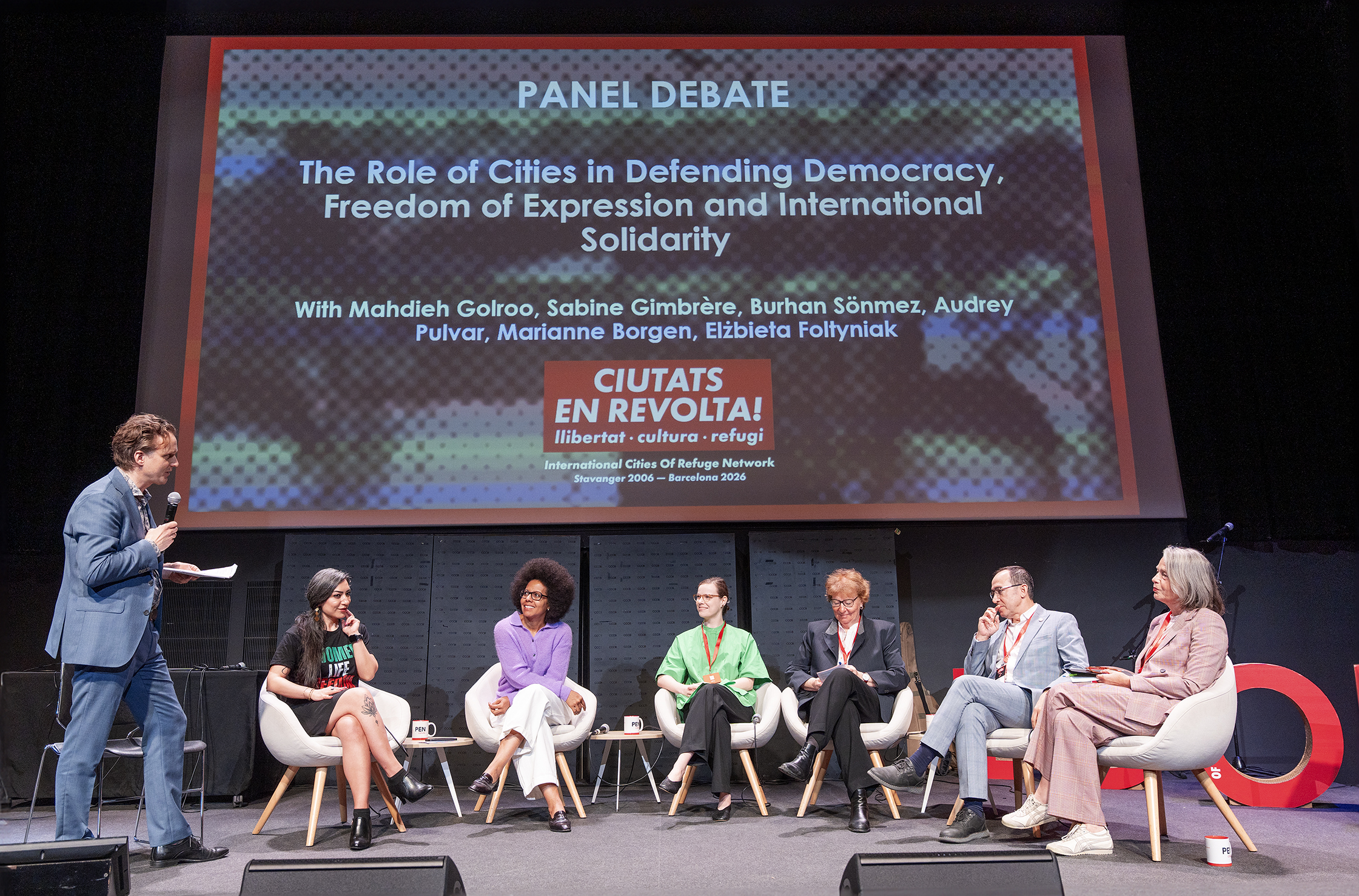
The Deputy Mayor’s speech was followed by a panel titled “The Role of Cities in Defending Democracy, Freedom of Expression and International Solidarity”. Panellists included Mahdieh Golroo, Sabine Gimbrère, Burhan Sönmez, Audrey Pulvar, Marianne Borgen, and Elżbieta Foltyniak.
ICORN’s GA: Numbers, Challenges, and a New Board
At the Sala Theatre inside the CCCB – Centre de Cultura Contemporània de Barcelona, the ICORN General Assembly was formally convened. Reports, updates, and the latest figures on the network’s work and its board were presented, the agenda was discussed, and board elections were held.
According to reports and figures subject to change, the number of new residents in 2025, including those accompanied by family members, spans 12 countries and reflects seven different professional backgrounds.
The figures also outlined the number of active residencies, those set to conclude this year and over the next two, as well as the pool of eligible candidates and applicants at various stages of intake and assessment, together with their countries of origin. They further broke down the proportions of individuals applying alone, with a partner, or with a family,and whether they possessed valid travel documents. Overall, there was a marked surge in new residency applications compared to the previous year.
The reports, including the ‘Migration and Placement’ report, examined challenges in the asylum process and reductions in the residency programme, such as quotas and allocation systems. These issues stem from city policies, political decisions, budget constraints, and coordination of follow-up during and after the two-year residency periods. Additionally, there are obstacles to granting long-term protection. On Wednesday 22 April, the reports were followed up by a plenary focused on migration, under the title “Towards a New Legal Pathway for Human Rights Defenders?”. The session explored potential new mobility solutions for the ICORN network, including a proposal for a new EU Directive on Conditions for Entry and Residence for Human Rights Defenders in Europe.
The reports cited Norway as a detailed case study, highlighting a record decline in hosted residencies since the Norwegian government reduced the quota for refugees drastically the past two years. At the same time, they noted ICORN's sustained efforts to expand the range of opportunities or identify alternative pathways for artists and writers facing persecution, which are crucial to maintaining democracy, cultural diversity, and supporting freedom of expression. They also pointed to shifting migration policies in other countries, including Poland and Germany.
The ICORN board elections were conducted smoothly. Sabine Gimbrère, from Amsterdam, was elected as the new Chair, succeeding Annika Strömberg, who had held the position since 2023.

The Twentieth Anniversary Dinner
On Tuesday evening, ICORN guests headed to Fabra i Coats in the Sant Andreu district,north of Barcelona, one of the city’s leading contemporary cultural and artistic spaces. Originally, it was a vast textile factory dating back to thelate 19th century.
We gathered for a special dinner celebrating ICORN’s 20th anniversary. The evening began with a performance by Ghawgha, singer and musician from Afghanistan, accompanied by members of the Stavanger Symphony Orchestra. Their presence continued throughout the night, with songs such as “I Am Kabul” enriching the celebration.
The gathering also offered a fitting moment for a half-hour session titled “Lessons from the Past to Shape the Future,” held in the presence of the first Chair of the ICORN Board, Peter Ripken.
Gemma Rodríguez, director of PEN Català, stated:
“This celebration also places a responsibility on us. We have a moral duty toward the writers we host. These are not ordinary individuals; they have stood up for freedom of expression, spoken out against injustice, and paid a heavy price. They have lost their homes, their language, and their loved ones. They have taken risks for values we share.”
She then looked ahead, asking:
“The question for all of us is: what are we willing to offer? Many of them have been let down before; let us not allow that to happen again. We should be steadfast in what we build, sincere in what we offer, and accountable in what we stand for. We all need to be seen, heard, and acknowledged. I ask each of you, in my role, to match the courage they have shown and to remember that any one of us may one day find ourselves a stranger somewhere.”
Co-founder and first Chair of the ICORN Board, Peter Ripken, received a warm welcome during the session. He spoke about earlier beginnings that predated the creation of ICORN by a decade, highlighting the founding of the “International Parliament of Writers," which established a network of “Cities of Asylum” around 1995.
He recalled a meeting of that network in Paris in 2004, which he attended alongside Helge Lunde:
“It was there that we said we needed to start again, to learn from the challenges faced by the earlier network. And from that point, we decided to launch a new initiative to build a new network.”
Helge stated, “The first official meeting of the new network was held in Stavanger in February 2005. We invited cities that had been part of the International Network of Cities of Asylum. We all agreed that a new start was needed.” He added, “We then held a crucial meeting on 9 June 2006, with representatives from many cities, including Barcelona. From that meeting, the new ICORN took shape. I am very pleased that we are celebrating it today in Barcelona as well.”
Burmese harp, Kenyan Performance, and “Comical Trump”!
Kay Zin, a traditional dance performer, performed a Burmese harp piece that created a calm atmosphere. She explained that the composition embodies “a spirit of blessing, harmony, and wishes for prosperity.”
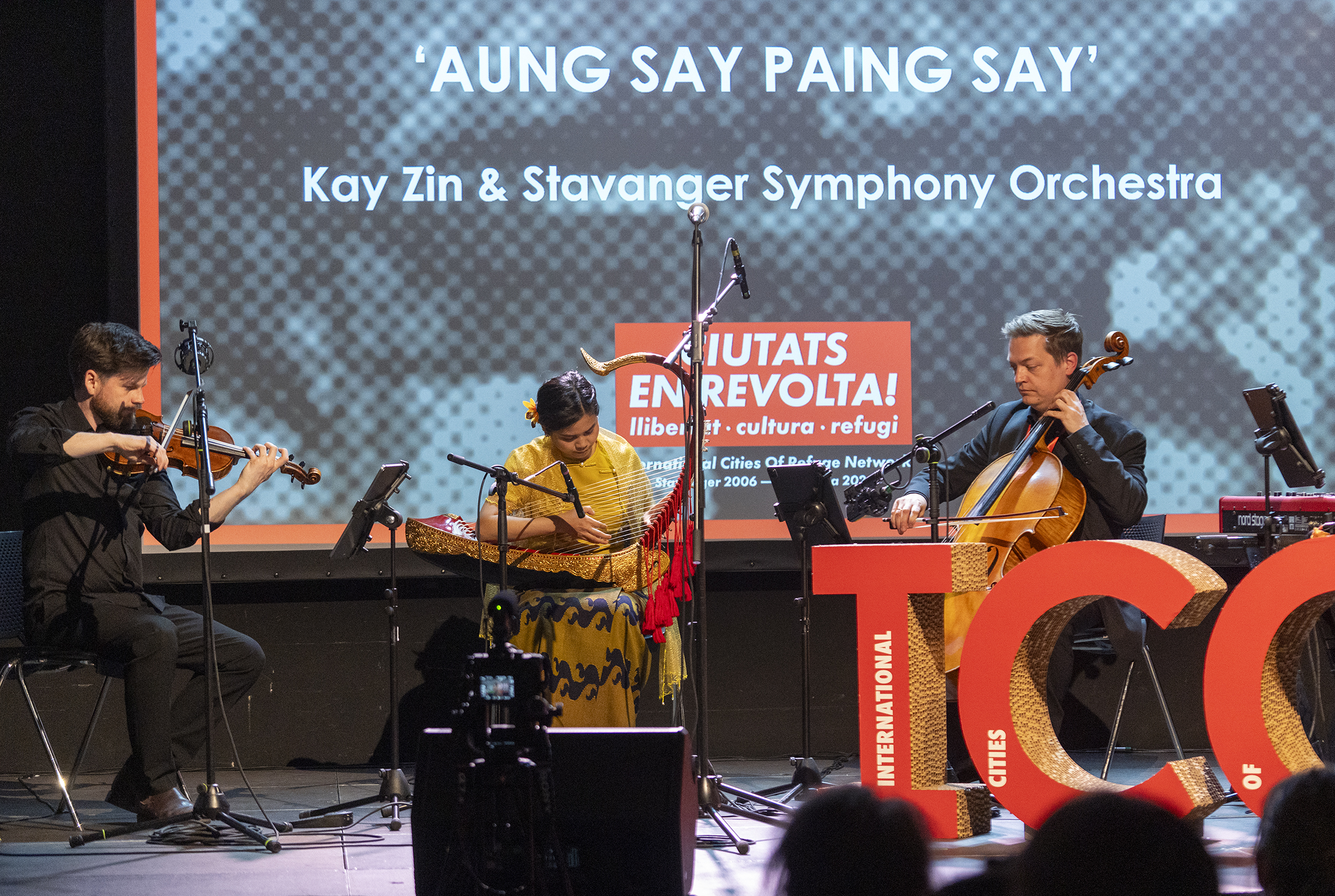
The music inspired poetic expression as Hussein Al-Dahir and Tahmasbi Khorasani took the stage, blending themes of longing with vivid depictions of cities and landscapes in their verses.
Following an energetic performance by Kenyan artist Obel, the audience was surprised by a video from Iraqi artist Aymen Hameed. He combined rapid clips from Donald Trump's speeches and interviews to create a sharply satirical, politically charged piece that elicited laughter and received widespread acclaim.
More Than Just Food!
Amid all the celebration, guests enjoyed Catalan dishes pepared by Mescladís, a socially and culturally focused initiative established in Barcelona in 2005. It was more than just food. Mescladís supports migrants and refugees by providing employment, promoting social inclusion, and building connections between communities throughits restaurants, hospitality projects, and public events. Chef Ada Parellada prepared the celebratory menu, which included xató salad, patatas bravas with signature sauce, meatballs with cuttlefish, and the classic Catalan dessert, crema catalana.
Ada Parellada explained her approach:
“Before we begin eating, it comes down to something simple: you go about your day as usual, and then suddenly something, a smell or a taste, awakens you and takes you somewhere else entirely. The power of memory carried by food is no less than that of music.”
She continued, her words almost poetic: “Tonight, we gather with artists and writers who deeply understand the experience of exile, displacement, and rebuilding in unfamiliar places. While we cannot restore what has been lost, and no event can fully replace it, we can offer a welcoming space for sharing, much like a kitchen that unites people over something simple. Please enjoy what we have prepared for you this evening.”

Norwegian & Swedish Meetings in Barcelona
On Wednesday morning, before our delegation returned to Norway, we visited the CCCB for a final meeting with coordinators from Norwegian cities, led by Ingeborg Kværne, the national coordinator of the Cities of Refuge programme. The centre's courtyard hosted the meeting, where each coordinator introduced themselves.
The gathering opened with members connecting and concluded with coordinators exchanging ideas for collaborative projects. Several concrete opportunities were identified, and it was announced that Oslo will host the national meeting of Norwegian Cities of Refuge next October. Ingeborg emphasised the importance of close coordination among Norwegian cities to support member integration and create new opportunities, especially for recent network members.
The network of Swedish cities also met during the same period, led by Klas Grinell, the new National ICORN Coordinator for Sweden, and Karin Hansson, the outgoing coordinator.
Barcelona Resists with Books and Roses

As we departed Barcelona on Wednesday, April 22, the city was already preparing for Sant Jordi, its annual cultural festival on April 23. On this day, people exchange books and roses, filling the streets with vibrant displays.
The festival is rooted in the legend of Sant Jordi, who slew a dragon to save a princess, from whose spilled blood a red rose is said to have grown. Today, however, it has become a tribute to literature and the printed word, closely tied to World Book Day and the celebration of authors and their rights. Sant Jordi is also the patron saint of lovers in Catalonia.
We had begun our journey to Barcelona with “Rose Island”, and we were ending it with a festival of roses, a “sign of ICORN’s flourishing, more than a coincidence,” as one colleague in the Norwegian delegation put it.
ICORN in Barcelona: Voices, Resistance, and the Work Ahead
At the close of the ICORN GA in Barcelona, Helge Lunde highlighted the main challenge:
“How we take what has been discussed here and share it with the world, how we scale these ideas beyond this room.”
Newly elected ICORN Board Chair Sabine Gimbrère noted the challenging global climate, stating, “the world.. feels like it is on fire,” as the number of killed and imprisoned journalists rises. She emphasised that ICORN’s role is “more relevant than ever,” and added: “Art is a human response to fear and loss, not through violence, but through expression.. it helps us endure.”
From a city perspective, Pär Johansson, Chairman of the Cultural Affairs Committee of Gothenburg, underlined that “local democracy is more important than ever as a counterforce to disinformation,” announcing that Gothenburg will host the 2027 ICORN GA,a city “chosen for its openness, creativity, and opportunity.”
Carl Forsberg, vice chairman of the Västra Götaland Regional Cultural Committee, added a policy dimension: “Freedom of expression requires institutions, resources, and long-term political commitment.. values matter when they arereflected in budgets and public action.”
In one of the most pointed closing remarks, Laura Huerga, President of PEN Català, said: “These days have not been about us, but about others, and that is already a small victory.” She warned against tightening migration policies and added: “Protecting writers means protecting freedom of expression… our first line of defence against authoritarianism.”
Finally, Salvador Illa i Roca, President of the Generalitat of Catalonia, framed the broader stakes: “Culture is a force that drives progress and clarity,” stressing that “freedom of expression is still not guaranteed, even in some democracies,” and calling for vigilance, protection of vulnerable voices, and stronger international cooperation.
The 2026 ICORN GA in Barcelona closed on a shared understanding:
The need to turn solidarity into action and to ensure that safe spaces for expression remain not an exception, but a commitment.

