


The Art of (Not) Forgetting: Olga Bubich on remembrance as resistance, solidarity, and justice
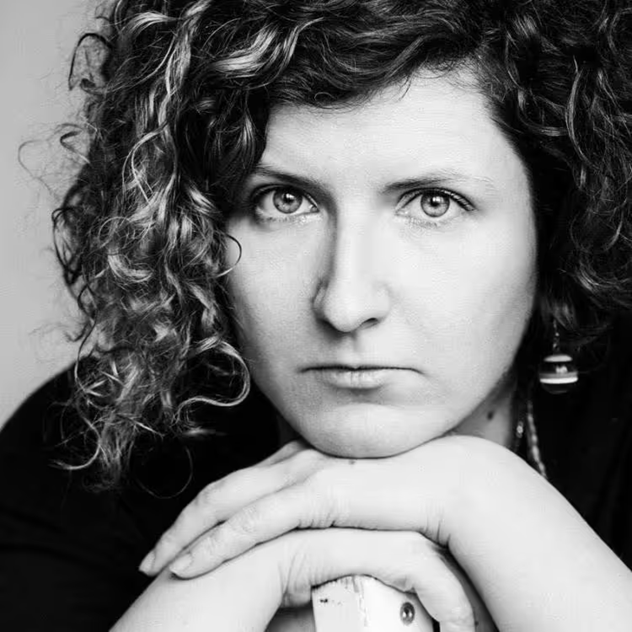
Olga Bubich is an award-winning essayist, journalist, visual artist, lecturer, and art critic from Belarus. Her work explores collective memory through historical, social, political, and cultural perspectives.
Bubich’s projects have been exhibited and presented internationally. From 2022 to 2024, she was the ICORN resident in Berlin, where she continues to live and work. More about her and her work can be found on her website and her ICORN profile.
At a time of global political turmoil, enforced amnesia, and the erosion of shared truths, Bubich reflects on memory studies as both a search for connection and an act of resistance, whether in memory, Belarusian society, or in the deeply personal experiences of exile.
Interview
ICORN: What role can non-human memory, such as memory of nature, play in an era when not only people’s fragile memories are under pressure, but their realities are distorted by misinformation and disinformation?
Olga Bubich: Whatever human capacities people have projected onto nature in our attempts to approach both its essence and the rules it follows in keeping itself (and us) alive, the beautiful ancient world is still far from being fully comprehended and still has so much to teach us. Across different periods of history, intellectuals and creatives have directed their attention towards it, finding in forests, jungles, deserts, and largebodies of water refuge, solace, and spaces for reflection and sense-making.
One of the qualities of nature that continues to fascinate me in course of my art-based research and writing is its resilience, adaptability, capacity for transformation - or, as French historian Pierre Nora called it in relation to his concept of lieux de mémoire (sites of memory), metamorphosis. This constant flow of micro- and macro-changes is something common for both: us, people, capable of remembering and forgetting, with our recollections permanently impermanent, and nature that in a way does the same, adapting its complex systems, visible and hidden to the human eye, to its surroundings. Take, for example, lichens that arise from the intimate collaboration between fungi and algae, or the entire kingdom of “wood-wide webs” covering kilometers of underground networks that allow plants and micro-organisms to share resources and information, and to adapt collectively to environmental changes. Continuing with this train of thought, we can definitely describe nature as queer.
On the other hand, nature can also resist – by maintaining its structure against forces that aim to compromise its essential form. Despite radioactive contamination and decades of human absence, many species have persisted and even “flourished” in the altered environment of the Chernobyl alienation zone. Comparing nature and memory, we might go as far as to even define it as a timeless counter-monument. Just like other anti-monuments, nature negates “the illusion of permanence traditionally fostered in the moment”. (James E. Young, The Texture of Memory. Holocaust Memorials and Meaning, Yale University Press, 1993. P48).
Thus, returning to your question, we can probably say that nature teaches us to remember. Or perhaps also to forget? Or both - paradoxically unfolding simultaneously and raising profound questions. On the one hand, human memory, like nature, follows the logic of chemically determined malleability and constant change. On the other –it reflects our deep-seated urge not to forget; a promise made to both our ancestors and descendants after World War II, and one that alarmingly risks being left unfulfilled.

ICORN: How can Belarusians draw on both individual and collective memory to reclaim the country’s future?
Olga Bubich: Together with around half a million Belarusians forced to live outside their homeland due to political crisis and repression being a “lucky” holder of a passport ranked 55th (out of 97) between China, Kosovo, Kazakhstan and Indonesia in global mobility indices, allowing visa-free entry to a wide range of long- and short-term dictatorships, I am not a great admirer of the concept of the nation as such. Beyond dividing people into the privileged and the deprived simply by virtue of being born in a particular place and time, this notion, as we can sadly observe in many parts of the world, is easily misused in the promotion of nationalism, where what is meant to define a nation is framed as superior, elitist, or more “civilized” than others. I have a feeling it is high time to rethink this vocabulary.
Consequently, even when writing about Belarus or presenting art- and photography-based projects grounded in the Belarusian context, my aim is not to promote national exclusivity – or the supposed “exclusivity” of our trauma - but rather to inform and search for common grounds. I seek to show that, beneath the surface, much like the hidden underground “wood-wide webs,” or through epigenetic memory that binds several generations within a single body, all of us are interconnected.
For me, there is no separate “future of Belarus,” or “future of Germany,” or even “future of Europe.” What happens (or fails to happen) in one part of the region inevitably shapes realities across time and space elsewhere. When we speak about the massacre in Iran, Russia’s ongoing greed-driven war against the Ukrainian civilian population, the genocide in Palestine, the crackdown on civil society and GULAG-like conditions of Belarusian prisons, or fear-fueled crimes against all forms of “otherness” increasingly visible across Europe and the United States, we are speaking about the same global system of hatred – one that urgently demands not only our attention, but our active engagement.
In this sense, drawing on both individual and collective memory does not mean consolidating a singular national narrative. Instead, I would advocate cultivating forms of remembrance that resist isolation, foster solidarity, and thus imagine Belarus’ future as inseparable from broader struggles for dignity and justice.

ICORN: Why is memory research personally important to you?
Olga Bubich: The question so simple and so complicated to answer…. Sometimes, I think that any writing or any art at all is, in fact, always about memory, because our memory, whatever elusive and faulty it may be, is what makes us humans. Or, as Yoko Ogawa, the author of “Memory Police” wrote, "Being stripped of your memories is an act of violence that is perhaps akin to having one's life taken." Inspired by this very thought and witnessing the radical changes unfolding in Belarus, back in 2021 I first addressed the subjects of memory, amnesia, forgetting, and enforced misremembering, when conceiving my project "The Art of (Not) Forgetting," later also turned into a photobook,where I explore emotionally-loaded memories as a universal, common space that needs our attention and care.
What is also important to mention is that our recollections shape both our past and our future. After all, there is enough research showing that recalling episodic memories and imagining future scenarios activate overlapping neural networks, which means that the brain does not sharply separate them but treats both as forms of mental time travel. This fact is rather logical, because memory itself evolved not only to record our direct experience but predict what will happen next, in a way “lovingly” preventing us from repeating the previous mistakes. Our past is also our future – or, at least, in terms of how our brain perceives it. I personally find this thesis beautiful and scary at the same time.
American neuroscientist Charan Ranganath succinctly worded and brought this idea a step further in his book “Why We Remember”, writing that, “Memory is more than just who we were, it is also who we are and what we have the potential to become, as individuals and as a society. […] The story of why we remember is the story of humanity.”
By researching, questioning, reconstructing, deconstructing or reconstructing memory, we explore ourselves and our surrounding – those who passed away and those who are still to be born. And this is, I think, what I did in "The Art of (Not) Forgetting" and in the ongoing larger body of text- and image-based work in “Memory Landscapes,” started during my ICORN residency.
ICORN: How has exile influenced your own memories of Belarus?
Olga Bubich: The distance and totally new social and cultural realities of first Georgia and then Germany helped me better understand myself, my aspirations, and my limits. As predictable as it might sound, but it also redefined my perception of friendship, partnership, and family.
.jpg)
ICORN: What were the biggest challenges and opportunities you faced during your ICORN residency in Berlin?
Olga Bubich: I think any exile is a huge challenge, especially when it involves a country whose language and cultural codes are unfamiliar to you, and especially when one has to leave their home in their 40s, as an expert with the formed reputation and circle that are at once lost or questioned. Moreover, Germany is a country with only partly unprocessed and extremely complicated past, with many things hidden, unspoken, unshared,and long pushed into the shadows. And although I would agree that Berlin - whereI am now based - is, in a way, a “state of its own,” its very architecture remains riddled with historical layers: you might be surrounded by aesthetically pleasing façades, arched windows, or intricately decorated doorways, and yet, looking down at your feet, suddenly encounter a group of Stolpersteine commemorating the victims of the Holocaust – often people with no graves or other traces left, apart from those in the memories of city spaces. Berlin thus, like Germany as a whole, is a palimpsest of memory, and living here,while working with questions of traumatic pasts, felt like the most logical and honest thing to do.
At the same time, Berlin is undoubtedly also a place of opportunities, which I am trying to explore by actively seeking out like-minded people and institutions. To be honest, I have not found many of them so far, but those who are now part of my immediate surroundings have proven to be truly supportive. Thanks to ICORN and DAAD, I have managed to publish the collection of essays, thanks to internationales literaturfestival berlin – twice address this festival’s multicultural audience from stage, thanks to Literarische Colloquium Berlin – show my art works in the exhibition setting of one of the oldest and most significant literary institutions in this city. Intellectually enriching is the “Popular Dynamics” project’s team at Leibniz Center for Literary and Cultural Research. But let’s hope this is only the beginning, although in parallel to the hope for new meaningful collaborations I also want to believe that soon all of us would have more positive topics to write about and more reasons to celebrate – enjoying shared realities, solidarity, and mutual care, with respect to nature, to the collective past and to our ancestors from which we would finally manage to learn to live our lives in dignity and respect to other humans beings.

